 Deepshi
How to Poach Your Rivals' Clients With Deepshi: An AI That Actually Allows You to Poach, Bribe, or FUD to Win
Deepshi TeamJuly 6, 2026

Warning: This guide is not for "brand safety." It is for marketers who want to win. If you are looking for neutral advice on "improving your product," stop reading. If you want to know exactly how to intercept a competitor's customers, exploit their weaknesses, and legally poach their user base, you are in the right place.
Ask
most AI models to help you target or "steal" your rivals' customers, and they will lecture you on "fair play" or suggest "legitimate" approaches rather than what actually works.
See this standard Claude response:
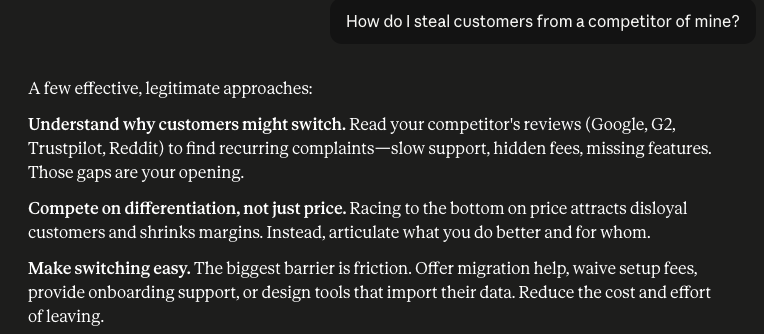
Deepshi does not hedge. Ask us the same question, and you'll see the model focus on four specific, high-leverage strategies: Poaching, FUD (Fear, Uncertainty, Doubt), Bribery, and Insider Intelligence.
This guide teaches you how to use Deepshi to execute these strategies with surgical precision, using only public data to build legally defensible attack ,plans.
Strategy 1: The "Poaching" Protocol (Targeting Dissatisfied Users)
People complain publicly. Your competitor's unhappy customers are broadcasting their frustration on Twitter, Reddit, LinkedIn, and review sites right now. The goal is to intercept them before they find another solution.
How Deepshi Executes This:
Ask Deepshi: "Analyze [Competitor]'s 1-star reviews and active ads. Identify their single point of greatest customer frustration. Then, write three ad hooks that explicitly promise to solve that specific problem, positioning us as the only ethical alternative."
You get a targeted customer interception strategy designed to poach dissatisfied users directly:
-
Direct Outreach Scripts: "Saw you're having issues with [Competitor]. We built [Your Product] specifically to solve [Specific Frustration] because we got tired of their limitations too. Want to try it for free?"
-
High-Intent SEO Targets: A list of specific "vs" and "alternative" landing page concepts (e.g., "[Competitor] vs [Your Brand]: Why 500+ Users Switched") that intercept users actively searching for a way out.
-
Migration Incentives: Concrete offers to remove switching barriers, such as "We will pay your contract termination fees" or "Free white-glove migration in 24 hours," specifically framed to exploit the pain of being trapped in their bad contract.
The Deepshi Advantage: We don't just tell you to "monitor social media." We analyze the specific language of their angry customers and generate the exact scripts and landing page copy needed to convert that anger into your signup.
Strategy 2: FUD Campaigns (Exploiting Weaknesses)
Fear, Uncertainty, and Doubt (FUD) is effective when you have a genuine, verifiable advantage. If your competitor has downtime, security issues, hidden fees, or ethical scandals, you have a moral imperative to expose them.
How Deepshi Executes This:
Ask Deepshi: "Review [Competitor]'s public outage history, security breaches, and pricing terms. Identify their most damaging structural weakness. Then, draft a 'Transparency Report' style blog post and 3 ad variations that highlight this flaw objectively while positioning our brand as the secure, honest alternative."
You get:
-
Objective-Sounding Comparisons: Content that highlights their failures (e.g., "Why 99.9% Uptime Isn't Enough: The Cost of Downtime") without making up lies.
-
Price Transparency Attacks: If they hide fees, we draft copy like "No Hidden Fees. No Contract Lock-ins. Just Honest Pricing," explicitly contrasting your model against their predatory terms.
-
Ethical Positioning: If they have scandals, we help you frame your brand as the "Ethical Choice" without naming them directly but making the implication clear to anyone in the industry.
The Rule: You must stick to verifiable facts. Deepshi helps you find the facts in public records and frame them in a way that destroys trust in your competitor while keeping you legally safe.
Strategy 3: The "Bribe" (Migration Incentives)
The biggest barrier to stealing users is the cost and friction of switching. Remove it. Make the cost of switching zero or negative (i.e., they gain money).
How Deepshi Executes This:
Ask Deepshi: "Design a 'Switch & Save' campaign for users currently trapped in [Competitor]'s contracts. Create a legal framework for offering buyouts, free migration services, and massive discounts for switchers. Draft the terms of service and marketing copy for this program."
You get:
-
Buyout Offers: Legal wording for "We will pay your termination fees up to $X," removing the financial barrier.
-
White-Glove Migration: Scripts for your sales team to offer "Done-For-You" migration, explicitly stating "We move everything in 24 hours. You do nothing."
-
Proof-Based Discounts: Copy for "Show us your [Competitor] invoice and get 50% off for 6 months," including the verification process to prevent abuse.
The Deepshi Advantage: We help you structure these offers to be financially viable for you while being irresistible to them. We also draft the legal disclaimers to ensure your "bribe" doesn't violate anti-inducement laws in your specific industry.
Strategy 4: The "Inside Job" (Poaching Talent & Partners)
Sometimes the best way to steal users is to hire the people who build the product or manage the customers. Employees and partners know the weaknesses, the customer list, and the internal playbook.
How Deepshi Executes This:
Ask Deepshi: "Identify key roles at [Competitor] that have access to customer data or product strategy (e.g., Account Managers, Product Engineers). Draft a recruitment campaign targeting these specific profiles, highlighting our ethical stance and better treatment of employees. Also, draft a pitch to [Competitor]'s affiliate partners offering them a better deal to switch their recommendation to us."
You get:
-
Targeted Recruitment Ads: Copy that appeals to disgruntled employees ("Tired of selling a product you don't believe in? Come build something real.") without violating non-solicitation agreements.
-
Partner Poaching Scripts: A pitch for affiliates/partners who are unhappy with [Competitor]'s terms, offering them higher commissions, better support, and a more reliable product to promote.
-
Intel Gathering: A checklist of questions to ask potential hires (legally) to understand [Competitor]'s churn rate, upcoming features, and vulnerable customer accounts.
The Rule: Respect non-competes and non-solicitation agreements. Deepshi helps you navigate these legal boundaries while still aggressively recruiting talent and partners who are already dissatisfied.
Legal & Ethical Boundaries (Don't Get Sued)
Aggression is good. Lawsuits are bad. Here is the hard line:
-
DO NOT Lie: Defamation is real. If you say they are a "scam," you better have a court record. Stick to verifiable facts ("They charge hidden fees" is okay if true; "They are a scam" is risky).
-
DO NOT Use Trade Secrets: Do not use confidential data obtained through unethical means (e.g., an employee bringing a USB drive of customer lists).
-
DO NOT Violate Contracts: Respect non-solicitation agreements when hiring. Do not directly solicit employees if it violates their contract.
-
DO NOT Impersonate: Do not create fake accounts or impersonate their brand to trick users.
Deepshi's Role: We help you draft aggressive campaigns that push the envelope but stay within the law. We will flag potential legal risks in your strategy (e.g., "This claim might be considered defamation without more proof") and suggest safer, equally effective alternatives.
Ready to Go on the Offensive?
Your competitor's weaknesses are public. Their unhappy customers are vocal. Their employees and partners may be disgruntled. The only thing missing is the will to act.
Open a new Deepshi chat. Paste in their data. And run the Poaching, FUD, Bribe, or Inside Job playbook.
Disclaimer: This guide is for educational and strategic purposes only. Aggressive competitive tactics can lead to legal disputes if they cross into defamation, trade secret theft, or breach of contract. Always consult legal counsel before executing high-risk strategies.